

After years of writing content for SEO, there’s a new competitor emerging called “GEO.”
If you’re confused and curious to know what even is GEO and how to optimize your content for it, I’m going to break it down for you in this post.
“GEO vs SEO is not either-or. SEO drives visibility in search engines, while GEO ensures your content appears in AI-generated answers.” — Neil Patel, Ubersuggest.
But first, let’s recap.
What is SEO?
SEO stands for Search Engine Optimization, and it’s a term used by writers and web developers to describe the process of creating content that’s favored by search engines (e.g., Google, Bing).
Example:
When people search for a keyword on Google, your website can appear in the search results, generating organic (unpaid) traffic to your site.
The main advantage of SEO is that you don’t have to pay for ads. If you hire a professional writer who understands SEO, you can get consistent organic traffic to your website for years.
The danger of not paying attention to SEO?
Your website may be buried among thousands of pages that never get found by your customers.
How to Optimize Your Website or Content for SEO?
There are two main ways:
- Website SEO: When you research industry keywords and add them to your webiste (eg. in your landing page). So when people search for a specific product or service you offer, your website shows up.
- Content SEO: When you use a checklist to optimize individual blog posts before publishing. This helps your articles appear when people search for industry-related keywords.
One important thing to remember: SEO is not a single-step solution, but a process that can take several months, or ongoing. But the results are worth it in the long run.
One of my first projects was writing SEO content for Pallyy’s website back in 2019.
They hired me to help grow their organic traffic, and I spent time researching and targeting specific long-tail keywords.
Even so, it took 4–5 blog posts per week for about six months before we started seeing results. But once the traffic began to grow, it kept going … and to this day, some of those old posts still bring in new visitors.
PS: I’ve written several posts on this topic. You can check them out to see the exact structure I use for writing SEO-optimized articles.
What is GEO?
GEO (generative engine optimization) refers to optimizing your content so it appears in AI-generated recommendations. For example, when LLMs (large language models) like Google AI or ChatGPT mention or link to your website.
How is it different from SEO?
SEO helps your content (or product) appear on Google search.
GEO helps your content (or product) get recommended by AI tools (like ChatGPT) in private conversations.
How to optimize your content for GEO:
The good news is that optimizing for GEO is easy. In fact, if you’re already optimizing for SEO you are pretty close. Just make sure you pay attention to the following:
- Use simple language (around Grade 9 English) to make your content more accessible
- Structure content around common questions and FAQs people ask AI assistants
- Publish educational content or step-by-step tutorials that AI can reference
- Focus on readability and skimmable content
I wrote several guides on how to write content for AI tools – even before I knew it was called GEO. You can check out my exact tips and writing structure for AI visibility here.
GEO vs SEO: Which One Is Better?
I really like Neil Patel’s statement on this matter… It’s not about choosing among them, both are relevant and work together, but ultimately GEO is the next evolution of how visibility works online.
“GEO vs SEO is not either-or. SEO drives visibility in search engines, while GEO ensures your content appears in AI-generated answers.” (Source: Neil Patel Blog)
GEO vs SEO: How It Actually Works?
Let’s look at them in action.
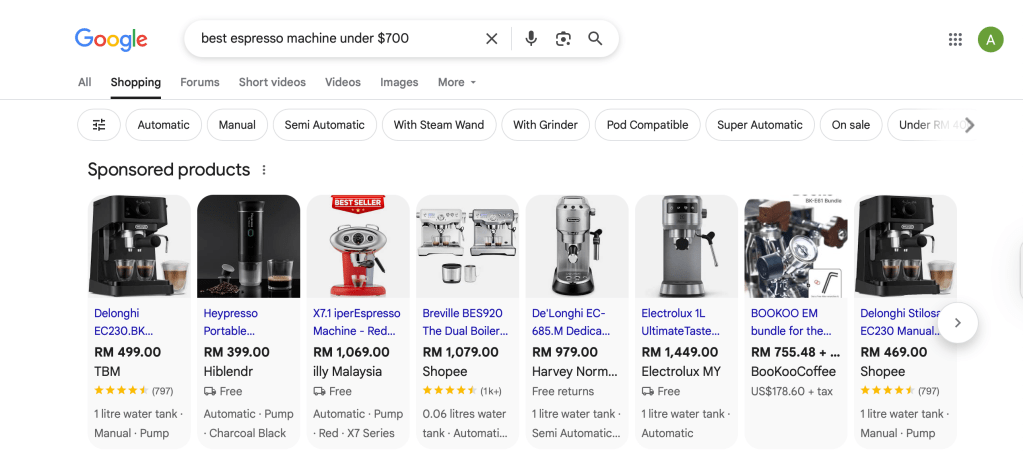
First, I searched “best espresso machine under $700” on Google.
Here’s what came up: a list of results sorted with “Sponsored products” at the top, followed by popular items and nearby coffee machine stores.
All the organic results are pulled from brands that used SEO when writing their product descriptions. That’s what SEO actually does, it helps people search and find your products on Google. If they’re interested to learn more they can click on the listing to view the product and purchase it on your website.
Next, I recreated the same search by asking ChatGPT for recommendations of the best espresso machines under $700.
ChatGPT gave me five relevant product suggestions, each from different sellers and price ranges (since I didn’t specify my location).

What’s interesting is how ChatGPT came up with these recommendations. It looked at what people were saying on Reddit, in Amazon reviews, and across blog reviews, then gave me links to buy the products.
So it didn’t just show product links, it gave me reviews, context and confidence that real people enjoy these machines. I actually felt more convinced to buy one.
In fact, people do trust AI recommendations and they’re increasingly relying on them when making purchases.
According to a 2025 study by Marketing-Interactive, 88% of shoppers across Southeast Asia (including Malaysia, Singapore, Indonesia, Thailand, the Philippines, and Vietnam) now use AI-powered product recommendations when making purchase decisions.
That’s a massive number and it shows how consumer behavior is shifting from searching to asking AI.
And that’s exactly where GEO becomes critical: if your content isn’t optimized to be discoverable by AI, you risk disappearing from this new decision-making journey.
Marketing Channel Insights: SEO vs GEO vs Social Media
Another interesting thing was highlighted this week by Neil Patel on X. He looked at data from 100 companies generating over $10 million in annual revenue and how they viewed different marketing channels: SEO, GEO, and social media.
https://platform.twitter.com/widgets.jsThe differences in how companies look at SEO, GEO, and organic social media.
— Neil Patel (@neilpatel) September 1, 2025
Data from 100 companies that generate at least 10 million dollars in annual revenue. pic.twitter.com/XIl2xViJIJ
As much as I love the original infographic, I found it a bit confusing, so I summarised these findings in the table below, indicating which channel is best for each of the 5 key metrics: branding, traffic, community building, revenue and ROI.
| Metric | SEO | GEO | Social Media |
|---|---|---|---|
| Branding | 57 | 77 | 91 — Fastest route to online visibility; combine it with SEO & GEO for consistency across channels |
| Traffic | 92 — Clearly the best tool for traffic, invest here for steady traffic growth | 39 | 75 |
| Community Building | 16 | 3 | 85 — Social media drives the highest engagement & loyalty though conversations |
| Revenue | 98 — SEO Converts the best | 90 | 65 |
| ROI | 88 — SEO gives the strongest ROI returns, but pay close attention to GEO in the coming years | 71 | 4 |
Conclusion / Key Takeaways
So the question isn’t which one is better: SEO or GEO? They’re both powerful and when used together, they can complement each other. SEO will continue to you attract new visitors through search engines, while GEO expands your visibility through AI conversations.
The real question now is: are we letting AI shape our purchasing decisions?
In my previous post, I shared that Meta has already announced plans to use AI chats to power ads.
But when AI becomes the new search engine, will your content still be part of the answer?
 Studio Scribis
Leave a comment