

Yes, it’s absolutely possible to start a career as a writer or content creator in 2026.
I’m sure you’re aware the internet is already full of people sharing writing tips and strategies. The problem? Most of these tips from “experts” and guides out there usually push you to buy another course or add more tools to your writing stack.
Here’s the truth: In 2026, you don’t need new ideas or new AI-powered dashboards and tools.
You already have a million of great ideas and the writing skills to create original content. What you actually need is a clear workflow, or a plan that actually works for you. One that helps you finish writing tasks, submit projects on time, and avoid just being “busy” working on never-ending content.
I’ve been a content writer since 2019, and in this post, I want to share my writing system and the tools that keep me stay focused and productive.
Let’s dive in!
Disclaimer: Some of the links in this post are affiliate links, and I may earn a small commission if you make a purchase through these links. These earnings will support my writing and come at no extra cost to you.
1. Start by setting new goals
It’s easy to overthink it, but really, my advice is just start writing. It’s better to just get started than wait for the perfect idea to fall from the sky.
If you’re asking yourself:
- What should I write?
- Where to publish?
- How often should I publish?
Let me break it down for you in the example below:
Example: A realistic monthly writing plan for 2026
Here’s a copy of my 2026 content plan to inspire you:
1. Write 1 long-form article/blog post per week.
Aim for 1,000-2,000 words per article.
This larger piece can be a “How to” guide, a “Step-by-step” tutorial, an educational piece, but most importantly it’s something helpful and valuable for your audience.
It also should be SEO optimized, helping you pull new traffic every week for years to come. You can check out my guide on how to write AI-optimized articles that can help you get ChatGPT citations in 2026.
Example: This guide on AI chatbots for Universities I wrote for Wonderchat.io
2. Write 2-4 short-form pieces per week.
These mini-blogs can be about 300-600 words each.
In terms of content, you can get inspiration from what’s currently trending in your industry, (eg: industry news), sharing your personal journey or expand points from your longer articles.
Best part? These posts don’t need to be heavily optimized, but should be interesting to read, and you can really show your unique personality.
Example: This mini-blog post I wrote for Pallyy.com.
3. Create 2-3 social media posts/week to promote your article links.
I find Twitter and LinkedIn the easiest platforms to re-share website content with direct links. But you can also experiment with sharing short clips on Instagram stories or YouTube shorts – but only if you’re willing to invest the time.
This plan should get you covered for the first 3 -4 months of the year. After that, you can revise your content strategy and find ways to improve it. But my advice is to just start writing: NOW, or as soon as you can.
Don’t overthink it. In 2026, originality is better than perfection.
2. Create a workflow that helps you grow in 2026
Here’s the main problem all writers (big and small) face: scattered workflows.
We search for ideas in one place, write ideas another place, and publish in blogging platform. We are promoting posts on social media, and then tracking views in Google Analytics … and so on.
Sounds familiar?
This complicated workflow makes it difficult to track projects. And not to mention, the thought of going through a number of different apps, steps and tools just to get a blog post published is daunting…
True story: I once had to upload a blog post into a client’s custom platform (I won’t name names). The editor kept crashing. I had to go through 5-6 steps just to get back to my draft. And worse: my work didn’t save. So, I lost hours just struggling with the tool.
That’s when it really clicked for me:
In 2026, a reliable, professional website like WordPress.com should be the central hub of your work.
This website that I’m talking about is not just a place to publish articles. It should be able to replace most of your workflow, so everything lives in one place.
Here’s what a simplified writing workflow looks like in 2026
Here’show my actual writing workflow looks now:
- Get ideas: Ubersuggest, Google search, reading industry news, Twitter trends
- Draft outlines: Google Docs (copy + paste in WordPress.com)
- Write, optimize & publish articles: WordPress.com
- Share on social media: WordPress.com (direct integrations)
- Track insights: Jetpack by WordPress.com (mobile + desktop)
That’s it.
I’ve simplified almost my entire workflow into one platform: WordPress.com. This is where all my writing, publishing, and social sharing are centralized in one place.
My step-by-step workflow in 2026
Step 1: Get ideas for blog posts
I’m a big believer that ideas can find you in unexpected places. I usually get ideas from reading the news, or having conversations with friends or various topics.
But if I need validation, I’d use a research tool and type in a keyword to see what other topics people write about.
PS: If you want to learn more, have published several tutorials on how I do my keyword research for blog posts, you can check them out.
Step 2: Draft the post outline
Once I get the main idea, I start writing the key points I plan to talk about. I use the old-school pen & paper and write:
- 3 main points for short articles
- 6 main points for long-form articles
For me, personally, the ideas keep flowing better on a piece of paper.
You can, of course, type your main outline and points in a digital note-taking app if you prefer.
But scribbling and rewriting ideas is FUN!
Step 3: Create a new post in WordPress.com
- Log into your WordPress.com admin dashboard.
- Click + New and select “Post” from the drop-down menu.
Here’s a look at the admin dashboard, and how to create a new post:
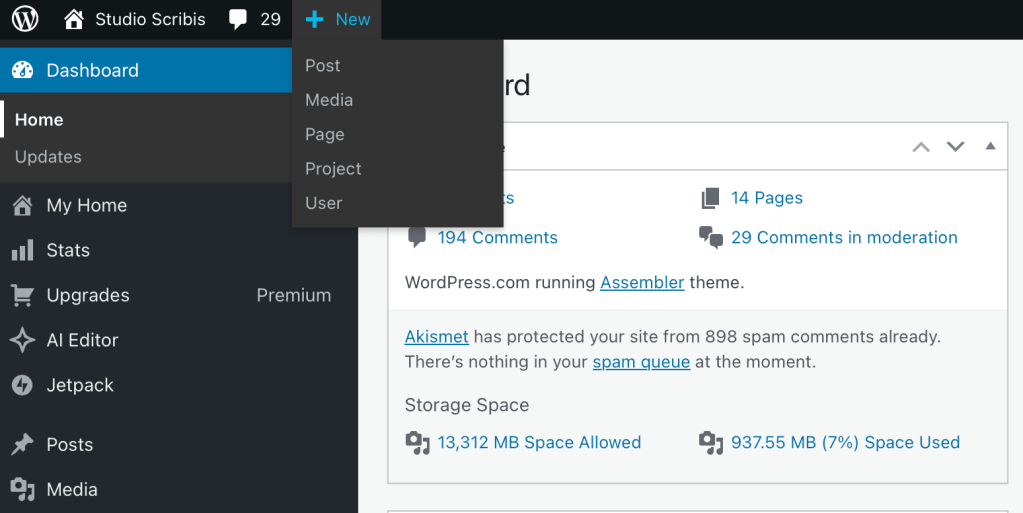
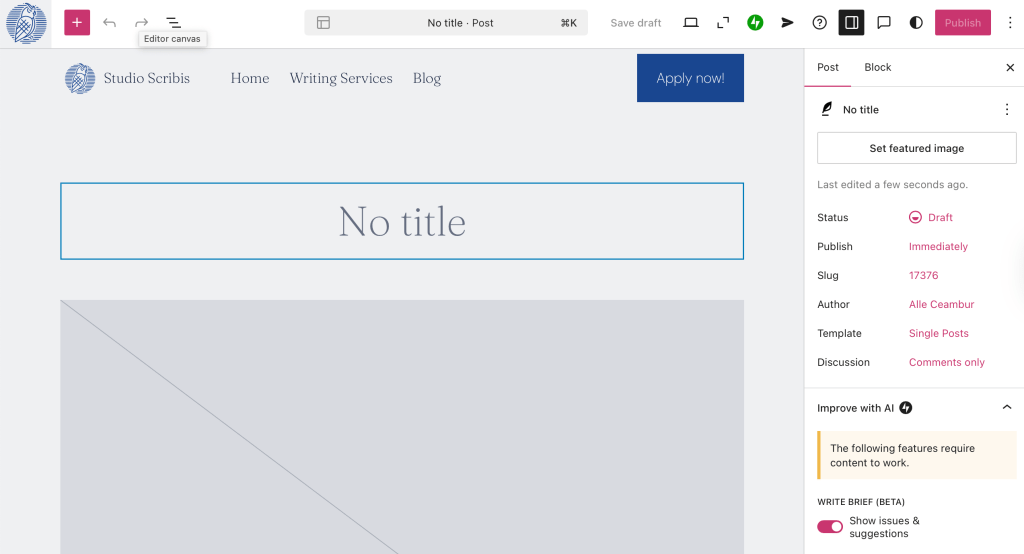
This will launch the new post editor page, where you can:
- Type your post into the editor, using the in-built tools for formatting headlines, paragraphs, adding URL links, images, etc.
- Or just copy + paste text from a tool like Google Docs.
Here’s how the post editor looks like:
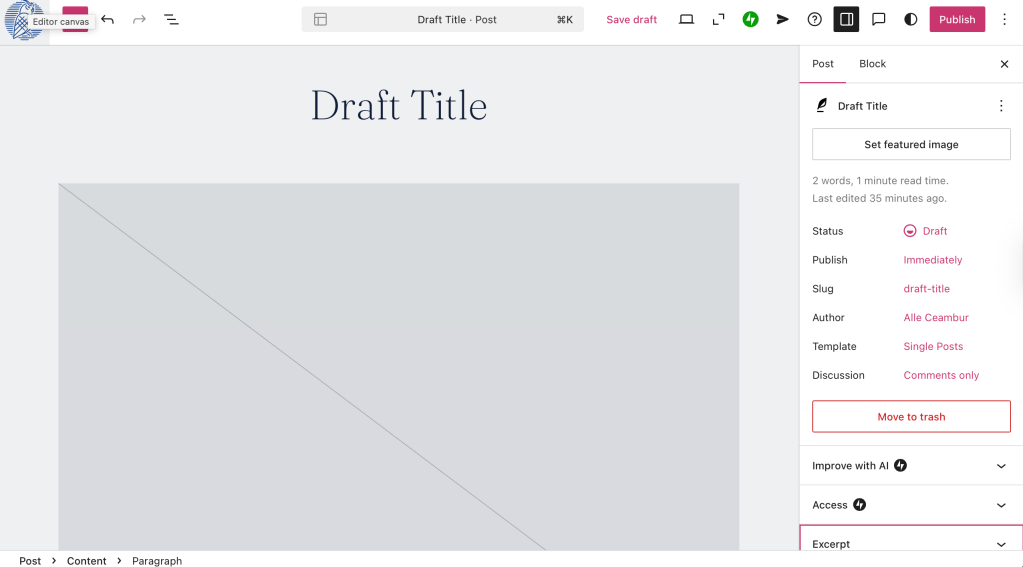
Step 4: Finalize and format the blog post
Use the features on the right-hand panel to adjust the post settings:
- Add a featured image
- Write a SEO-friendly Title
- Edit the URL slug
- Add keywords
- Choose tags and categories
- Decide if you allow comments
- Edit the author name
Tip: Check out more cool features available on WordPress.com for writers and bloggers.
Step 5: Publish & share on social media
- Click publish immediately or schedule for a later date
- Type a short message for auto-sharing your post on your linked social media pages
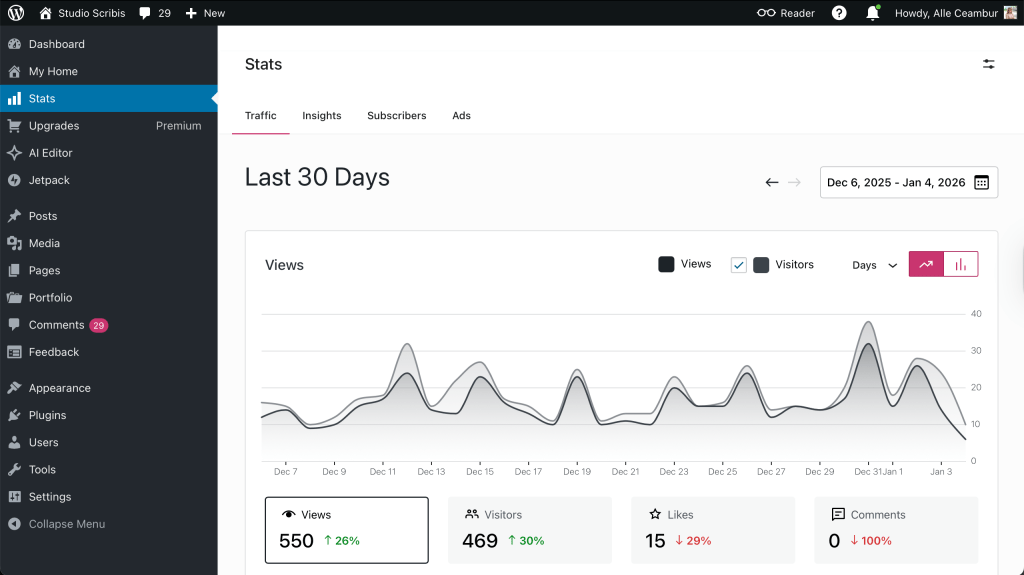
Then, you can use the companion Jetpack app to:
- Track post performance (views, visits, likes, comments)
- Understand what posts resonate with your readers
- Manage your blog publishing on the go
Now, let’s got to some common mistakes, that you should avoid this year.
Common Writing Workflow Mistakes to Avoid in 2026
Here are a few common mistakes I made, that you should take note and try to avoid:
Mistake #1: Focusing too much on the tools
When I started my blog, I thought that unless I invest in all the tools the best “writers” use, I won’t be able to write well. But that was the fact that stopped me from progressing.
I started adding:
- Idea generation apps
- Title generation tools
- AI plagiarism apps
- Grammar & proofreading apps
- Social media scheduling tools
- Email newsletter tool
While these apps can be helpful, but the result is this:
- More tabs open
- More notifications to keep track of
- Repeated tasks
- Less actual time spent on actual writing
My goal in 2026 is to remove all these distractions and focus on sharing my voice and publishing high-quality original content.
Mistake #2: Relying too heavily on social media
Building your entire workflow around social media platforms is a fragile strategy. Its not good for the long-term, as you don’t have control over the profiles.
Here me out, social media platforms can change so quickly.
The problem with that? Algorithms get updates every 6 months, and with that, accounts can get restricted for posting something that goes against their new terms.
I’ve had my Instagram account deactivated and shadow-banned twice since 2021. So, I learned my lesson the hard way.
That’s when I stared focusing more on having a website as the central hub of my brand. And this is what I recommend to anyone planning their 2026 strategy for their business.
PS: I shared why you need a website in 2026 as a writer in a recent post, and the dangers of not having one.
Mistake #3: You get too caught up in planning tools
My final advice: use content planning platforms, but only sparingly.
Yes, they’re nice to have, nice to drag-and-drop boxes around the screen, and nice to look at.
But don’t let these pretty dashboards, apps, and checklist tools get in the way of publishing more content. Posting good-quality content doesn’t have to be perfectly aligned. Sometimes, post ideas just come overnight (literally) and just feel right.
So trust your intuition and publish content even if it doesn’t always align with your dashboard.
Conclusion:
Writing in 2026 is different. We have AI tools to help, but they don’t replace having a structured workflow in place. A messy system and an overwhelming number of tools are a recipe for writer burnout.
And if you’re planning a reset in 2026 (like me), don’t start by adding more tools.
Start by building a focused workflow that supports your writing… not one that keeps you busy.
Have a great writing year in 2026! And don’t forget to sign up for a WordPress.com account and create a new website – if you haven’t already :)
 Studio Scribis
Leave a comment