
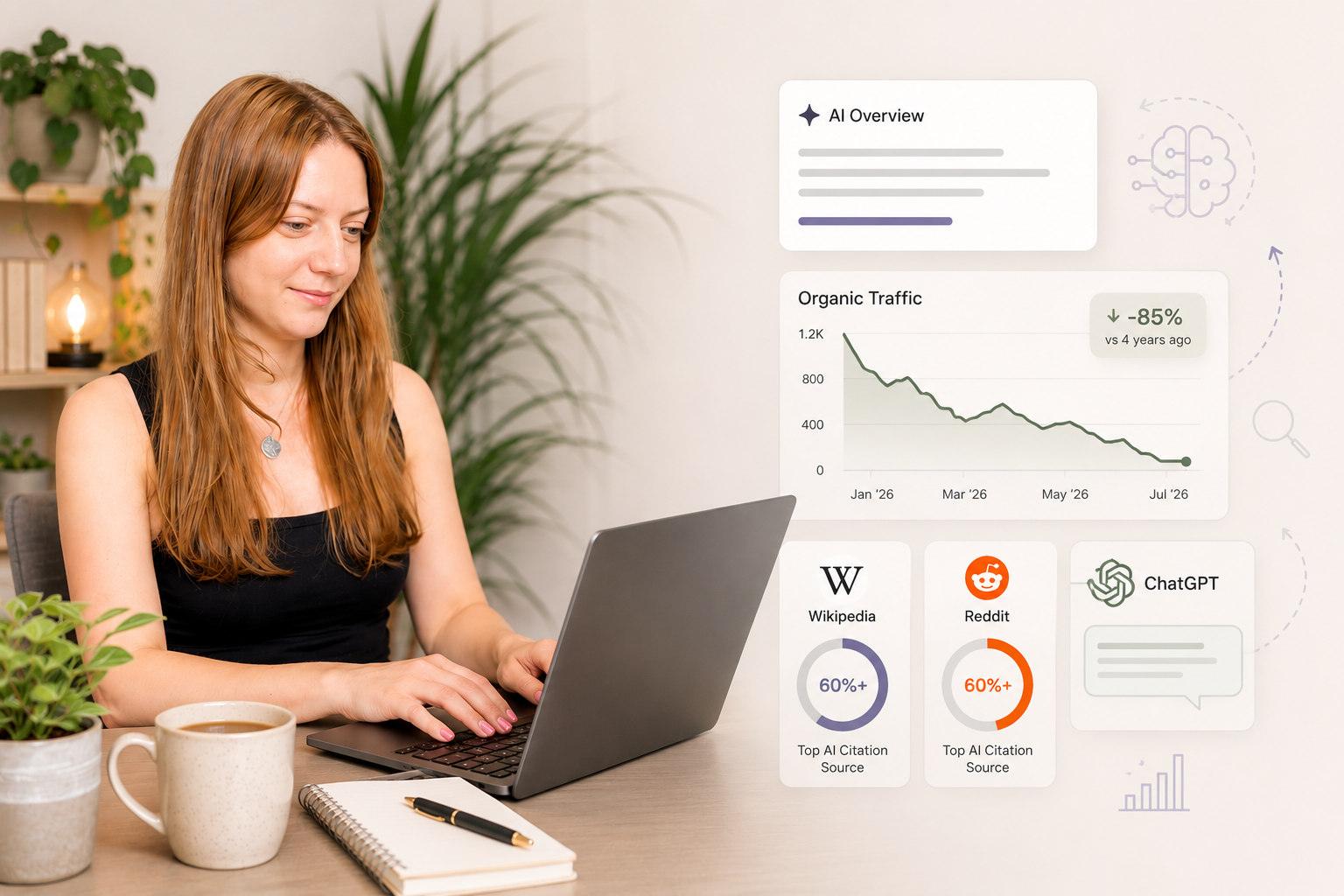
A few weeks ago, I wrote about the Google Core 2026 update that affected my website’s organic traffic. At that time, I thought it was a temporary phase, as with many algorithm changes before, and that my traffic would eventually come back. But that wasn’t the case. Instead, I think we’ve entered the “Zero-Click” era. And it’s not just my blog that’s getting low traffic; it’s a problem affecting everyone’s traffic.
The data showing zero-click traffic is the new normal
Daniel Stanica ran a study tracking organic traffic across 100 previously successful blogs over four years. The median blog in his data study lost 85% of its Google search traffic. More than half blogs lost more than 80%. Some blogs lost 99%.
It’s not just this one isolated study, either. Neil Patel posted about the same pattern two months ago; his agency has observed organic traffic fall across hundreds of client accounts, even those with perfect rankings. His take is that this isn’t a temporay glitch, it’s due to the shoft in how AI systems handle search. His advice is a total revamp of the success metrics bloggers use. For instance, moving away from rank positions and starting to track whether you’re getting cited in AI answers.
What my own data shows
Naturally, I looked at my blog stats, mainly referrer and traffic, and compared this month and a six-month time frame starting January this year.
Traffic drop
The first thing I noticed is that my traffic dropped sharply in January 2026, from over 1,000 visitors a day to just 231 visitors in July 2026, and stayed pretty low ever since. Then in May 2026, there was another Google update changing the way blog content is ranked. This major change makes it more difficult for review posts, how to, top 10 lists, and affiliate posts to attract organic traffic.

Referrer sites
Second, I looked at my blog’s referrers and noticed that Google is still referring search traffic (205 visits), but much less than January this year (832 visits), despite me publishing new content weekly.
Besides Google, Claude AI and Gemini are new referrers showing up in my current month views.
New referrers – July 2026

Referrer sites – January 2026
Search engines used to contribute a large amount of my site’s organic traffic in January 2026. There were not many AI citations, but instead social media platforms like Facebook and YouTube brought in visitors.

So why is this zero-click blog traffic actually happening?
Between Dan Stanica’s study and what Neil Patel’s agency is seeing, this decline in traffic stopped feeling like something I did wrong. Looking at my declining traffic and change in referrals, I understood that it’s not that my content got worse. It’s something deeper.
Several things are happening at once:
- Google’s core updates are now rewarding E-E-A-T signals. Content that shows experience, expertise, authority, and trustworthiness is now favored over “informative but generic” content that used to rank just fine but now can be summarized by ChatGPT in a few seconds.
- Google AI Overviews and LLM-generated answers are taking a large share of the search traffic. Major publishers in the US reported a 20-40% traffic drop due to Google AI overviews.
- The rise of Reddit and Wikipedia as the top two sources for AI citations, some studies give them over 60% share of total Google AI citations, replacing blogs like mine or yours.
The result: Your blog ranking can stay exactly where it was, and visitors, and clicks are stoll missing. That’s the part that stings. Your stats dashboard can look fine if all you’re watching is ranking position, SEO score, and not traffic sources, or clicks.
The new reality: low traffic is the new normal
Here’s the part I found difficult to accept as a blog writer. This isn’t just another algorithm update, or seasonal dip. Blogging used for getting traffic, the way it worked from roughly 2015 to 2023, is gone. If your entire content strategy is still built on posting valuable content, optimizing for SEO, ranking well, and getting clicks, you’re planning around a model that’s already gone.
That doesn’t mean blogging is over. It means what type of content we post, and how we measure success has changed.
Score your own blog
Stanica’s research points to four traits showing up again and again in the blogs that managed to survive and grow during the last four years. Here are the factors that you should pay attention to if you’re serious about fixing your blog or preventing it from dying.
The blogs that survived ticked at least two of these traits. The ones that grew, like Pinch of Yum, cleared four. So this is a good exercise worth doing for your own website, before you even look at the more technical metrics.
| Trait | What it actually means | Example of content |
|---|---|---|
| Firsthand experience | Content built on things you made yourself, tested, tried yourself or went and did yourself | A post walking through exact steps and mistakes from something you actually built, tried, discovered. |
| Owned audience | An email list, community, or following you actually control outside your blog | A newsletter-only update or a Q&A livestream |
| A real product | A book, tool, course, or something people can buy directly from you | A post linking to your own template, guide or service instead of an affiliate |
| Brand search | People typing your name or your blog’s name into Google, not just a generic keyword | A post titled with your own name like “Alle’s honest review of Buffer analytics” |
What I’m actually doing about it
1. Stopped tracking page views as my main KPI
I’m shifting toward metrics that measure trust, not traffic:
- return visits
- email signups from a post
- replies
- shares
- direct messages from people who read something and reached out
- newsletter clicks
These are more difficult to track in Google Analytics than pageviews are, so I’m still figuring out how to track this consistently without running different apps, but there’s no point in looking at low pageviews at this point, and I’d rather have a messier true picture than a clean false one.
2. Started building relationships I actually own
I am going back to my email list, sending monthly newsletters, and showing up consistently on video on YouTube and Instagram. If someone’s on my list or follows me on X, a Google core algorithm update can’t take that away.
I’m trying to be more visible and less “faceless blog,” which honestly doesn’t come naturally to me, but the alternative is staying fully exposed to whatever Google execs decide next quarter.
3. Shifting toward bottom-funnel content
I won’t post anymore generic “how-to” posts that are easily summarised by AI chatbots, and lose all traffic.
Instead, I already started creating posts from my own experience, like how I built a new coffee blog with WordPress.com AI Builder, where I detailed all the questions I asked, the mistakes I made, and included screenshots of every step.
This is more authentic, personal, and shows first-hand experience.
Besides that, content tied to a decision someone’s already close to making, like comparisons of tools I have tried myself, Threads vs Twitter, the kind of thing that needs my actual expertise rather than any generic answer.
That’s harder for an AI Overview to summarize away, because it’s not interchangeable with the next ten search results.
4. Auditing my old blog content
Daniel Stanica’s study makes a related point from a different angle: sites that pruned their older, thin, and easily summarizable blog posts and focused on a smaller set of pages backed by first-hand experience are outperforming much larger archives on almost every metric that counts now.
His research found that in some cases, a tightly focused 30-post site beats a 500-post content farm.
That’s pushed me to think seriously about auditing my own 200+ posts, removing older content that’s not helping me right now, and keeping only a handful of good quality posts.
5. Tracking refererers, including AI answers
This is not a new thing; I’ve been tracking referrer sites for years, but it was mainly social media and Google. But now I also want to know: am I getting cited when someone asks ChatGPT, Claude, Gemini, or Perplexity a question?
My WordPress.com site’s referrer data already shows traffic from claude.ai and Perplexity that simply didn’t exist a few years ago. Yes, it’s really small right now, but it’s the first sign of a channel I have zero visibility into otherwise.
This is why I’ve been using Semrush One – the first tool I’ve found that includes both traditional SEO diagnostics and AI visibility tracking in the same place.
I ran my own site audit through it, and the numbers backed up exactly what I was already feeling:

- Organic Rankings shows my keyword count holding basically flat (147 keywords), while my organic traffic has fallen from around 18 to 6 over the same six months (14.29% drop). While rankings stayed the same, I only got a third of the traffic. That’s the “dashboard lies to you” problem, in my own data.

- Traffic Analytics shows the same story from a different angle: organic search (in red) has been dropping sharply since January and hasn’t recovered.

- Site Audit’s AI Search Health score came back at 94%, and the “Blocked from AI Search” check confirmed I’m not accidentally locking out LLM citations, so if I’m not showing up in AI answers, it’s not a technical block; it’s more likely a content problem.
Semrush One works on any site, not just WordPress, if you’re wondering. What’s cool is that you can also use it to check the rankings of your competitors, not just a site you own.
If you want to see where your own content still shows up (in search and in AI answers), I recommend using Semrush One’s free trial, where you get 7 days free just for clicking through.
Where this leaves us bloggers
The honest answer is: I don’t have this fully figured out, and I don’t think anyone claiming they do is being straight with you.
But the bloggers who are still growing right now aren’t the ones clinging to the old traffic model based on rankings, they’re the ones who’ve already accepted that Google is one channel among several, and who’ve put real effort into YouTube, Reddit, LinkedIn, email, wherever their specific audience actually lives.
If your traffic chart looks like mine, you’re not behind. You’re just later to the same realization the rest of us are having right now.
Leave a Reply